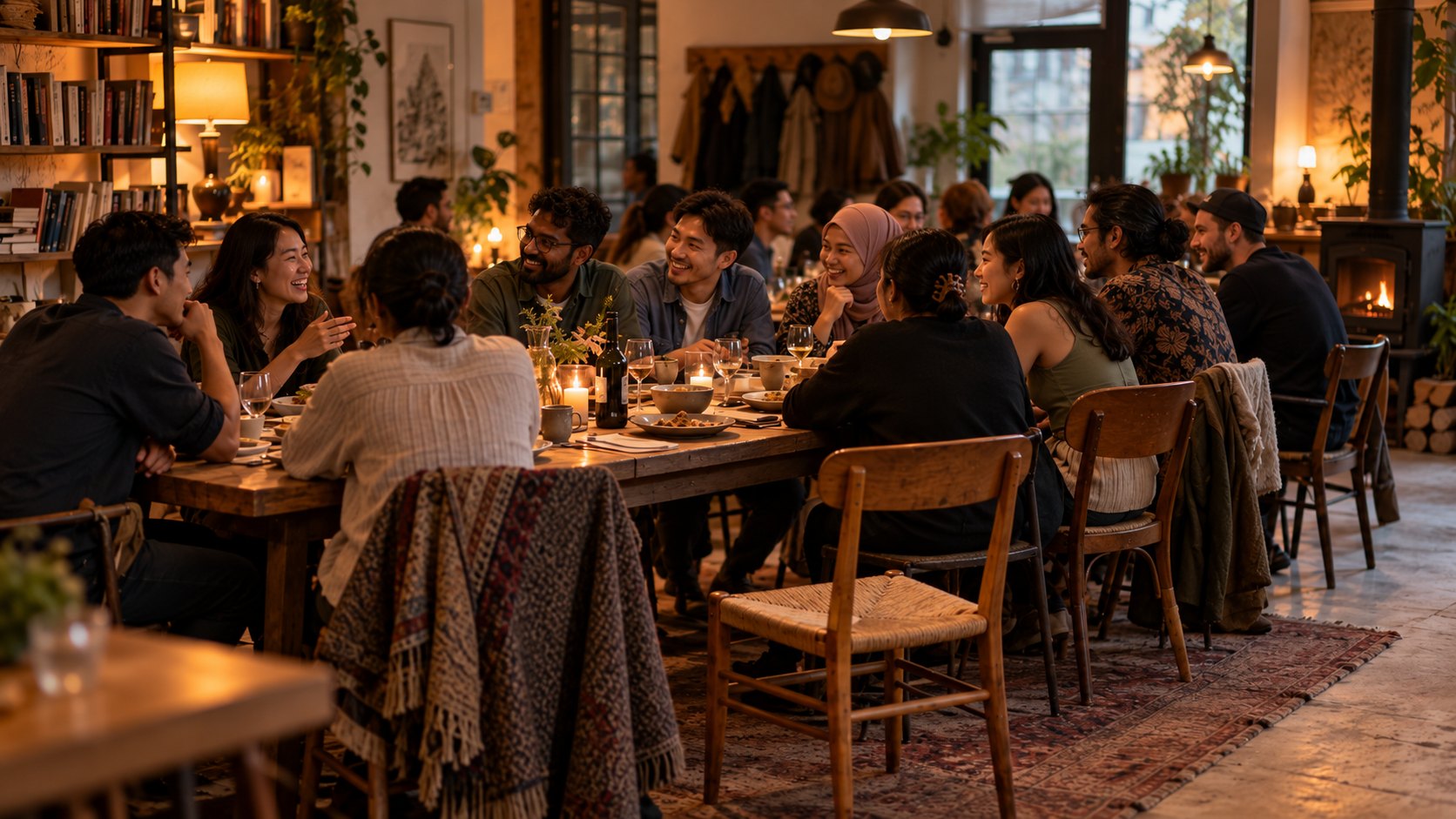
In Japan, about 40% of people now say they feel lonely at least occasionally. Meanwhile, the number of new running clubs on Strava grew 3.5-fold in 2025, and club-organized events rose by half, turning online communities into real-world gatherings.
Read together, these are not contradictory signals. They are a symptom and a response. People are lonelier. And some of them are lacing up their shoes to do something about it.
What is changing, and why now
Something interesting is happening to the value of physical presence. People are seeking rooms with other people again. Places where they can become familiar rather than visible. Where someone knows their name, rather than many people knowing their handle. Shared hours are beginning to matter more than shared posts.
The pressure behind this is both demographic and emotional.
Across the EU, single-adult households without children grew 19.2% between 2016 and 2025. In 2025, 22.5% of European adults were living alone or as single parents, and the proportion of people living alone was higher than in 2016 across every age group.
In Japan, the Cabinet Office projects that 29.3% of women aged 65 and over will live alone by 2050, up from 22.1% in 2020. For men, the projected increase is even sharper: from 15% to 26.1%.
These are projections, not destiny. But they show the direction of travel.
And the health stakes are becoming harder to dismiss. The WHO estimates that around one in six people worldwide experience loneliness. Among adolescents and young adults, it is closer to one in five. Loneliness was associated with more than 871,000 deaths annually between 2014 and 2019.
A condition once treated as private melancholy is now being measured as a public-health problem. The behavioral response is what I would call show-up spending. People pay not simply for access, entertainment or exercise, but for the obligation to be somewhere, with other people, at a particular time. The fixed hour is part of the product. So is the possibility that someone notices when you do not come.
Through the Triad
I read this shift through Naked River’s Human Being – Citizen – Consumer Triad, because a consumer lens alone misses what is happening.
The Human Being wants belonging without having to perform for it.
The Citizen is increasingly living in societies where social isolation has become a collective concern rather than simply an individual problem.
The Consumer, meanwhile, has spent two decades being trained to expect speed, frictionlessness and anonymity.
These three identities are no longer pulling in the same direction. Convenience says: do not make me wait. Connection says: give me a reason to stay. Digital culture says: reach everyone. Belonging says: notice me.
That tension creates opportunity.
But also exclusion.
The WHO finds loneliness particularly prevalent among younger people, while demographic change points toward a growing population of older adults living alone. These may look like opposite ends of society, but they share a problem: an absence of recurring social structures.
And who is left out of the emerging response? Anyone for whom the room is difficult to reach: people without the time, mobility, money or confidence to walk into a room full of strangers. A running club can be a gift to someone who already runs. It is rather less useful to someone who does not.
A trend that rewards the already connected is not necessarily a cure for loneliness. It can become another sorting mechanism.
The counter-signal
Foresight begins where enthusiasm ends. So consider the base rate.
In the United States, the amount of time people spent socially with friends in person fell from around 60 minutes a day in 2003 to about 35 minutes by 2019, before the pandemic pushed it down to just 20 minutes in 2020. Among 15-to-24-year-olds, the decline over the same period was almost 70%.
Any renaissance of physical togetherness is therefore starting from a very low floor.
There are other reasons for caution.
Strava’s numbers describe behavior around one platform and combine platform data with survey research. They are a useful signal, not proof of a universal social transformation. Government action is also remarkably immature. A WHO global review found that only eight of its 194 Member States had national policies addressing social connection, social isolation or loneliness. The desire may therefore be growing faster than the infrastructure required to support it.
Wanting to be known by name is not the same as showing up every Tuesday at seven.
What it could mean for brands
These are directions to explore, not prescriptions.
Reconsider what speed is worth.
For years, categories have competed to remove time: faster checkout, shorter waiting, instant delivery, seamless service.
But if people increasingly leave home in order to feel part of something, a fast anonymous transaction can begin to resemble the thing they are trying to escape.
Convenience is not becoming obsolete.
It is simply no longer self-evidently the highest form of value.
Design for being expected.
There is a profound difference between being allowed to enter and being expected to arrive.
Membership systems usually optimize access. They could instead optimize recognition.
A recurring hour. A familiar host. The same people. A saved seat. A ritual. Someone who asks where you were last week.
These are not decorative touches around an experience.
They may increasingly be the experience.
Think in rhythms, not events.
Brands are very good at staging moments.
Belonging is rarely produced by moments.
It comes from recurrence.
The interesting unit of design may therefore shift from the spectacular launch, activation or pop-up to something far less glamorous: Tuesday at seven, every Tuesday.
Reliability creates familiarity. Familiarity creates recognition. Recognition can become belonging.
Take the aesthetics of use seriously.
If the emotional promise is belonging, showroom perfection can work against it.
The visual language people may trust is closer to lived-in warmth: shared tables, soft light, evidence that somebody was there before you and somebody else will arrive after you.
Think of a Dutch interior painting, where the worn table often tells you more about life than the polished silver.
For some brands, a little wear may begin to read not as neglect, but as welcome.
The room itself becomes valuable
For much of the digital era, physical space was treated as an expensive container for the real product.
Retailers reduced it. Banks removed it. Services digitized it. Technology promised to make it unnecessary.
Perhaps we should invert the assumption.
When what is scarce is not access to things but access to other people, the room is no longer where the product happens.
The room is becoming the product.
And that changes what brands should be designing.
The question to take away
If your best customers went out tomorrow looking not simply to buy something, but to be known by name, what would they find in your world that knows theirs?
If that question is hard to answer, it may be worth an afternoon with your team. That’s what a Naked River Sprint is for.
Sources that informed this piece:
Cabinet Office of Japan, National Survey on Loneliness and Social Isolation (2024 survey, published April 2025).
Strava, Year in Sport Trend Report 2025 (December 3, 2025).
Eurostat, Household composition statistics (May 2026).
Cabinet Office of Japan, Annual Report on the Ageing Society, FY2024 (June 2024).
World Health Organization, From loneliness to social connection: report of the WHO Commission on Social Connection (June 2025).
Goldman et al., “National policy responses to address loneliness: a global scoping review of 194 WHO member states”, Health Policy (2026).
U.S. Surgeon General, Our Epidemic of Loneliness and Isolation (2023), drawing on Kannan & Veazie, “US trends in social isolation, social engagement, and companionship: nationally and by age, sex, race/ethnicity, family income, and work hours, 2003–2020,” SSM – Population Health (2023).