
Experiencescape: Why the Servicescape Model Can No Longer Hold

Something has quietly broken in the language we use to design brand environments.
For over three decades, one word has done most of the structural work in service and experience research: servicescape. Coined by Mary Jo Bitner in 1992, the servicescape described the physical environment in which a service was delivered — its ambient conditions, spatial layout, and functional signs. It was a precise and useful concept for its moment. Hotels, banks, and healthcare facilities could be evaluated through it. Managers could use it to identify where physical cues supported or undermined service delivery.
But that moment has passed. And continuing to design brand environments through the lens of the servicescape is like attempting to score a film using the grammar of radio drama. The medium has changed. The concept has not.
What the Servicescape Was Built For
Bitner’s model emerged from a specific set of conditions: service encounters that were primarily transactional, delivered in physical environments whose central purpose was operational. The servicescape was concerned with how the physical setting influenced both customer and employee behaviour — and rightly so. Its three components (ambient conditions, spatial layout and functionality, signs and symbols) addressed real design problems. Temperature, lighting, and noise levels affect mood and behaviour. Spatial configuration shapes movement and interaction. Signs direct and inform.
The model was valuable because it made visible something that had been largely ignored: the environment was not neutral. It was an active participant in the service encounter.
But the servicescape was never designed to hold meaning. It was designed to support function.
Why Function Is No Longer the Point
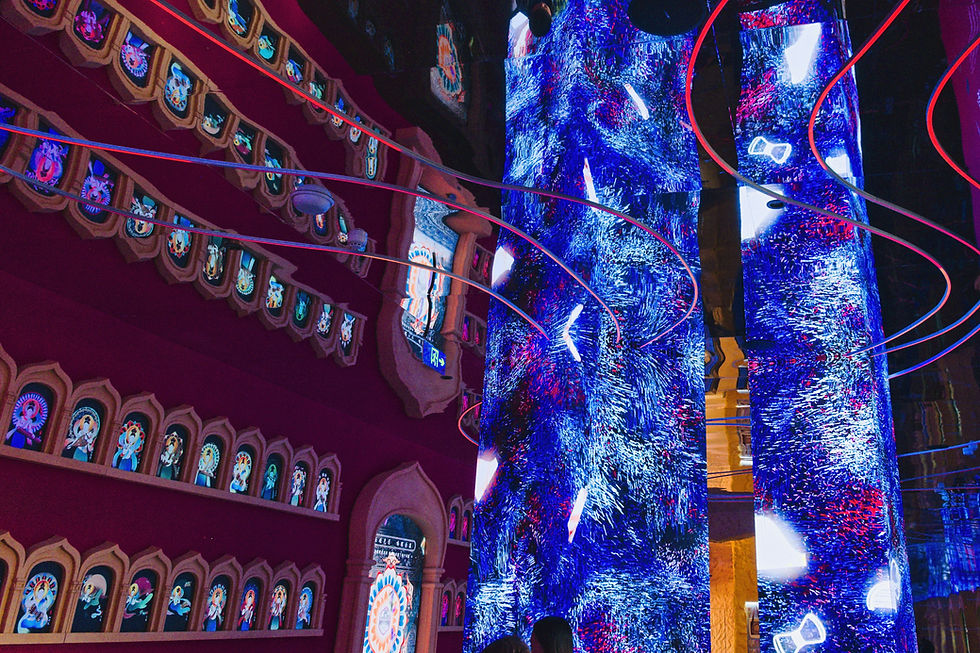
The environments that shape brand perception today are not primarily functional. They are narrative. They do not simply host transactions — they frame interpretation, propose worldviews, and create conditions in which emotional and cultural meaning can form.
Consider what Aesop does when it opens a new retail space. Each location is designed as an entirely distinct architectural proposition — a response to its urban context, its history, its materiality. The environment is not optimised for conversion. It is composed, the way a poem is composed: for resonance, for restraint, for the quality of the encounter it makes possible. Visitors do not leave primarily having transacted. They leave having been somewhere.
Or consider what Recess — a CBD-infused beverage brand — did with a temporary pop-up in New York. Rather than building a product showcase, it built a counter-environment: soft light, slowed tempo, muted colour gradients, and an explicit invitation to lie down and rest in a city defined by acceleration. The space did not merely display a product. It enacted a brand argument about what wellbeing requires. The environment was the message, delivered not through signage but through lived physical conditions.
These environments are not servicescapes. They are not optimised for delivery efficiency. They are not primarily concerned with ambient conditions as operational variables. They are meaning-bearing constructions — designed to shape perception, prime emotion, and hold narrative coherence over time.
They are, in a precise sense, experiencescapes.
What Experiencescape Means — and Why the Distinction Matters
The experiencescape, as I define it in Experience Design: From Brand Intent to Lived Memory (2026), is the designed environment in which an experience unfolds — physical, sensory, symbolic, and atmospheric. Unlike the servicescape, which is primarily a functional environment designed to support delivery and operational clarity, an experiencescape is a meaning-bearing, branded environment designed to shape perception, emotion, behaviour, and memory.
This is not a semantic distinction. It is a conceptual one.
The servicescape asks: Does this environment support the service encounter?
The experiencescape asks: Does this environment create the conditions in which meaning becomes possible?
These are different questions. They require different design processes, different evaluation criteria, and different relationships between strategy and space.
A servicescape succeeds when it gets out of the way of the transaction. An experiencescape succeeds when it is the experience — when the environment itself carries meaning that no message, no product, and no service interaction could carry alone.
The Four Forces That Shape an Experiencescape
The experiencescape does not stand alone. It functions as one of four interdependent components that together constitute an orchestrated experience system — an adaptation and extension of the Servuction model (Langeard, Bitner, Lovelock, and Eiglier, 1981) into experience design terms.

The user — the participant, the customer, the guest — sits at the centre. Around them:
The Experiencescape — the physical, sensory, symbolic, and atmospheric environment. Architecture, light, sound, materiality, spatial sequencing, temperature, and rhythm. Not a neutral container but an expressive medium: it communicates values, proposes a worldview, and subtly scripts how people should inhabit the space.
Contact Personnel — the human layer. Not merely service staff, but interpretive presences who read, adapt, and modulate the emotional tone of the experience in real time. In experience design, contact personnel are choreographed — not scripted into rigidity, but trained in narrative intent. Singapore Airlines understood this: the Singapore Girl is not a service icon but a carefully engineered system of recruitment, training, and emotional intelligence, designed to embody the airline’s values of calm authority and anticipatory care.
Other Customers — the social field. Co-presence is a design material. When managed deliberately, it generates what Durkheim called collective effervescence — the shared emotional intensity that transforms individual participation into collective meaning. When ignored, it fractures immersion. The silent observation code at a teamLab installation, the synchronized energy of a Red Bull Cliff Diving event, the communal repair ritual of a Patagonia Worn Wear workshop — all are experiments in designing the social field.
Invisible Organizations and Systems — what sits below the line of visibility. The backstage logistics, supply chains, and operational systems that make the experience function. Increasingly, the most sophisticated brands are making the invisible visible — not as transparency for its own sake, but as expressive material. Hermès’ Festival des Métiers, where artisans work on-site in full view, is not a PR exercise. It is a decision to treat process as part of the experience itself.
Together, these four forces constitute a system. The experiencescape is its most immediately perceptible layer — but it is only as strong as its alignment with the other three.
The Design Implication: From Container to Medium
If the servicescape was a container, the experiencescape is a medium.
Containers are evaluated by what they hold. Mediums are evaluated by what they communicate — and what they make possible in those who encounter them.
This shift has practical consequences for how experience environments are designed and briefed.
A servicescape brief begins with operational requirements: flow, capacity, accessibility, hygiene, efficiency. These remain necessary. But an experiencescape brief must also answer prior questions: What should this environment feel like before anything is said or done? What emotional state should it induce upon entry? What meanings should be available for construction, and which should be foreclosed? What sensory conditions should prime the body before interpretation begins?
These are not decorative questions. They are strategic ones — and they cannot be answered by the servicescape model, which was never designed to ask them.
The most consequential retail, hospitality, and cultural environments being built today are not servicescapes made more beautiful. They are experiencescapes from the ground up: environments in which the difference between a space that merely functions and a space that means has been understood, designed for, and relentlessly maintained.
A Diagnostic Question
The easiest way to test whether an environment functions as a servicescape or an experiencescape is to ask: What would be lost if you stripped away the brand identity?
In a servicescape, very little. The environment supports a function, and that function remains legible without a brand.
In a well-designed experiencescape, almost everything. The meaning is not applied to the surface; it is structural. It lives in the spatial sequencing, the quality of the light, the pacing of the service interaction, the restraint of what is not said. Remove the brand and you remove the logic that holds the environment together.
This is the standard against which the best experience environments should be evaluated — and the standard against which the servicescape model, however useful in its time, can no longer measure.
Closing Thought
In 1992, the servicescape was the right answer to the right question. The question was: How does the physical environment affect service encounters?
That question remains worth asking. But it is no longer the primary question. The primary question — the one that defines the competitive terrain for brands operating in physical space — is different:
How does the designed environment create the conditions in which meaning is possible?
To answer that question, we need a different concept. A different frame. A different set of design criteria.
We need the experiencescape — and a methodology to design it intentionally. The USDS Framework (Understand, Script, Design, Stage) developed in Experience Design: From Brand Intent to Lived Memory (Serena, 2026) offers exactly that starting point.
References
Bitner, M.J. (1992). Servicescapes: The Impact of Physical Surroundings on Customers and Employees. Journal of Marketing, 56(2), 57–71.
Langeard, E., Bitner, M.J., Lovelock, C., & Eiglier, P. (1981). Marketing of Services: New Insights from Consumers and Managers. Marketing Science Institute.
Serena, M. (2026). Experience Design: From Brand Intent to Lived Memory, ISBN 978–981–94–5874–5.


Comments